Sources and Methods #6: Elliot Ackerman


Show Notes:

[Recorded in Iraq]

2:55 - Alex's blogpost on note-taking [Note-Taking Jujitsu, Or How I Make Sense Of What I Read]

10:13 - I started working on my first book within days of leaving the military.

11:08 - Writing journalism used to be far more common, as a fiction writer. It’s an older model, but for me it’s always felt very natural.

Example: Graham Greene’s Quiet American.

Idea: When I’m starting a novel: It’s like I’m standing in a field of very very dry grass, and I’m trying to start a fire. And what I’ve gone in my hands are two flints, and I’m banging them together as hard as I can trying to make sparks. The flints are something I’ve seen, something I’ve experienced, and the fire is all imagination.

13:24 - The key to being a writer is to write. Every day. No matter what.

14:21 - Each idea often needs a bespoke process for how you’re going to approach that idea.

15:30 - I take umbrage with the rigid definition of ‘fiction writer vs. non-fiction writer.’ These are totally artificial definitions. Even when the subject matter is completely disassociated from the author, the emotional truths there are frequently real to that person’s life. I think of myself as a writer, and when I see subjects I want to approach, I’ll decide how I want to approach it: essay form, long-form, article, etc.

16:45 - Discussing the use of emotional experiences in writing, an excerpt from Elliot’s article published in the Daily Beast here which used one experience as a foundation for a long article:

The Fourth War: My Lunch with a Jihadi

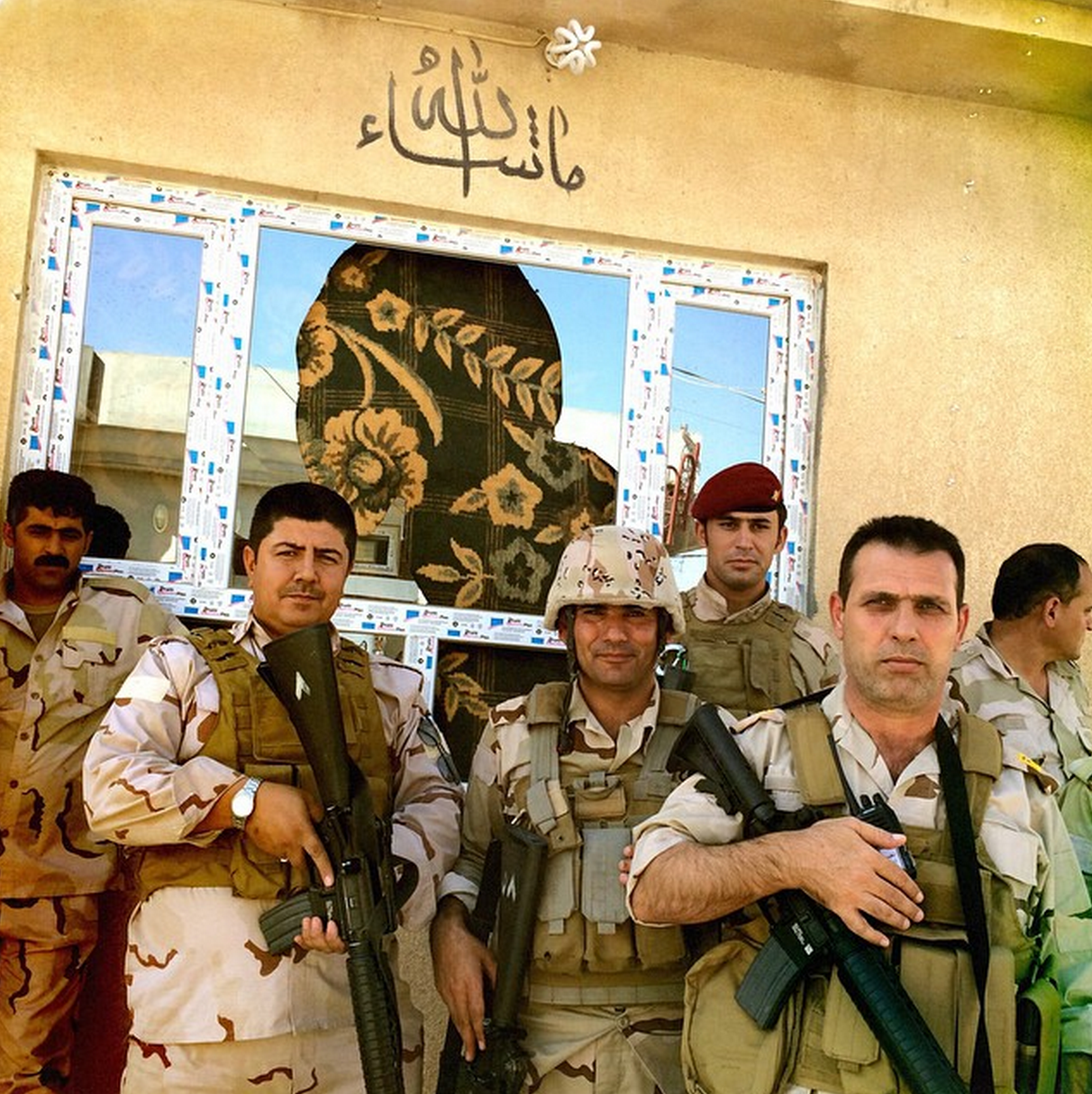
For a moment we sat, three veterans from three different sides of a war that had no end in sight. Not the Syrian Civil War, or the Iraq War, but a larger regional conflict. Amidst all this, Abu Hassar had hit on a unifying thread between us: friendships borne out of conflict, the strongest we’d ever had. I think that’s why I’d sought out Abu Hassar, to see if that thread existed among two people who’d fought against each other. And, for the first time, I wondered why Abu Hassar had agreed to meet with me, a so-called journalist he knew nothing about, except that I was American and had spent some time in Iraq. Maybe he, like me, had become tired of learning the ways we were different. Maybe he wished to learn some of the ways we were the same.

I agreed and Abed began to explain to Abu Hassar that I’d been a Captain in the Marines and had fought in Iraq and Afghanistan. I watched them intently, not understanding their quick Arabic. Abu Hassar began to slowly nod and his gaze moved from Abed to me. Then, once Abed was done, he picked up the water that had been set on the table. He poured a full glass in front of him, emptying his bottle. He handed it to me.

“A Captain,” he said. “So we were both like the handles of the spear.”

I nodded.

18:38 - A poem Elliot loves from the First World War that discusses the power of an emotional experience:

An Irish Airman Foresees His Death

19:30 - Fighting is a very intimate experience. You ask yourself - who were these people that defined me? And did I define them? The seeking is very natural.

23:54 - There’s a shared humanity that we had. Combat is a very human and visceral thing - you’re fighting to keep your friends safe, and yourself safe. He [Abu Hassar] had had those experiences, and I had had those experiences. It’s disorienting to come home and realize that you may have more in common with your adversary after having been through all this than you do with the people at home.

25:12 - The World War I Christmas Truce

25:48 - To talk politics for a second, I think it’s very dangerous to classify your enemy as irrational. That’s a pretty big hedge. If you look through the history of warfare and conflict, many of these people are rational. Now they might be looking at the world through a very very different framework than you are, and that gives them the semblance of being irrational, but if you just throw the baby out with the bathwater and say these people are completely irrational, you will probably have a difficult time formulating a strategy that effective against your adversary.

26:44 - My writing process often starts with an idea, and a first sentence. It will literally be one sentence. I’ll be walking around with it for awhile in my back pocket. And then it’ll be like I’m on the high dive - and the first sentence is you start moving on the board a little bit. And you put it down.

For me, I keep banker's hours about it. I have a word count I do every day. And I really try not to judge what I’m writing as I’m writing it. I’ll let the whole idea play out, and then the revisions begin.

28:02 - Green on Blue, told from the perspective of a young Afghan soldier who kills an American. Started with one sentence.

29:02 - It’s famously been said: writing is rewriting. But you have to start, and you have to keep going, and you have to get to the end.

30:57 - It’s important to disambiguate your business from your writing.

33:26 - In the novel, I wanted to take an action that at face value would seem like the most deceptive action we can see - when Afghan soldiers trained by Americans shoot one of their American advisors in the back, and I wanted to peel that back in a novel, and show the journey someone would take who would do this. So when the action is taking place, not only can you understand it, you find yourself thinking I would’ve do the exact same thing.

34:38 - Anytime you write anything, you’re trying to create an emotional connection to the reader.

35:56 - The fiction I enjoy isn’t prescriptive, it’s portraiture. It’s giving someone a real sense of a landscape and moral topography so they can decide what they think about that world.

37:06 - [on good fiction] It’s something that elicits an emotional or intellectual response in the reader.

38:28 - The Sound And The Fury: it’s not something everybody gets the first time they read it.

39:39 - Some of the greatest books are books people hate, and they create really interesting conversations. Read The Confessions of Nat Turner by William Styron, it’s about a slave-rebellion in the Virginia Tidewater area. Hugely controversial when it came out, but it’s a great book.

40:22 - I don’t know if there’s a criteria by which someone can judge fiction writing. Frankly, it’s one of the things I kind of like about it.

41:27 - I think it’s a fiction that there are ‘fiction gods’ (that you have to appease to publish). I think there’s a rough justice, but if something’s good, it’ll get picked up. There’s a sense that there’s an us vs. them, writers vs. publishers, but I’ve never found that to be true.

42:30 - If you’re a writer, you better strap on your rejection pants and get ready for it. That’s part of any artistic form - rejection. Lots of rejection. Great writers are rejected all the time. Established writers are rejected all the time. Again, divorce the business from the art.

On picking the next book: I find myself reading a lot on issues outside my world (not reading on Iraq or Afghanistan). I’m reading Love Me Back right now, it’s a coming-of-age story, and it’s amazing, gritty and powerful. So while I don’t have a specific process, I do make sure I’m always reading.

46:57 - Elliot on Twitter

47:30 - Reading international newspapers definitely gives a different perspective, and I would encourage everyone to do it. Where you can, it’s good to triangulate your news sources.

49:30 - On his writing process: I don’t leave where I am until I hit my daily word count, usually 1,500 words. And the evening is dedicated to reading. I’m often taking notes in the margins of things I’m reading and frequently go back to those things. And I’m very disciplined about writing ideas down - get it down, in a notebook or in the notes page in my iphone. I hate saying this because I’m the guy who was a Marine, but discipline goes a long way. When something comes in your mind, write it down. Take the time and do it. It’s amazing what you build if you crack at it every single day.

53:22 - Advice to aspiring fiction writers:

I think one thing I maybe did right early on - I suspended belief in a lot of ways. I said I’m just going to do this, and I don’t know where this is going to go, but I’m going to keep doing it. If you try to conceptualize an entire book, or think about a timeline or selling it - you just need to start. You need to enjoy it as much as you can - it may not always be enjoyable, but do it. And you have to be brave. I think it takes a lot of courage to write. I really do. And I don’t say that in a pollyannaish way. People are going to read your ideas and tell you whether or not they like them. People will say they don’t like it.

55:56 - On rejection, Norman Mailer’s The Naked and the Dead was rejected 25 times before it got published and then it was on the New York Times best sellers list for something like 60 weeks.

56:26 - Also, go find other writers. Tap into a community. If you’re going to be writing fiction, you need to be a good literary citizen.

58:45 - Faulkner has a great quote: The only thing worth writing about is the human heart is conflict with itself.

59:47 - I wouldn't necessarily encourage everyone to write. You have to want it. If it moves you. Not everyone should be a writer - or a banker or a doctor. I feel a compulsion to write. Even if my books were not coming out, I would still write. It's how I think. It's how I process events. It's how I distill meaning from the events in my life.

1:01:32 - I think it's dangerous to ascribe the value of your art to some end.

1:02:12 - I think if you're a writer, you need to publish.

Elliot's book: Andre Malraux’s Man's Fate

Elliot's film: The Seventh Seal by Ingmar Bergman.

Matt's book: This week, reading Dataclysm by Christian Rudder
Sources and Methods #2: Erin Cunningham

Alex and Matt are joined by Erin Cunningham, the Egypt-based correspondent for the Washington Post. Erin has previously worked for Global Post and the Christian Science Monitor in Afghanistan and across the Middle East and North Africa. We discuss how she goes about telling the stories of the people who live in places like Egypt, and why she thinks it's important work. We delve into the practicalities of her job and how she keeps track of things going on in the region.

Erin Cunningham on the Web

Erin on Twitter

Erin at the Washington Post

Erin at The National (UAE)

Erin at The Christian Science Monitor

Erin at Global Post

Erin's Tumblr

Erin's Instagram


Erin Cunningham 101: What to Read

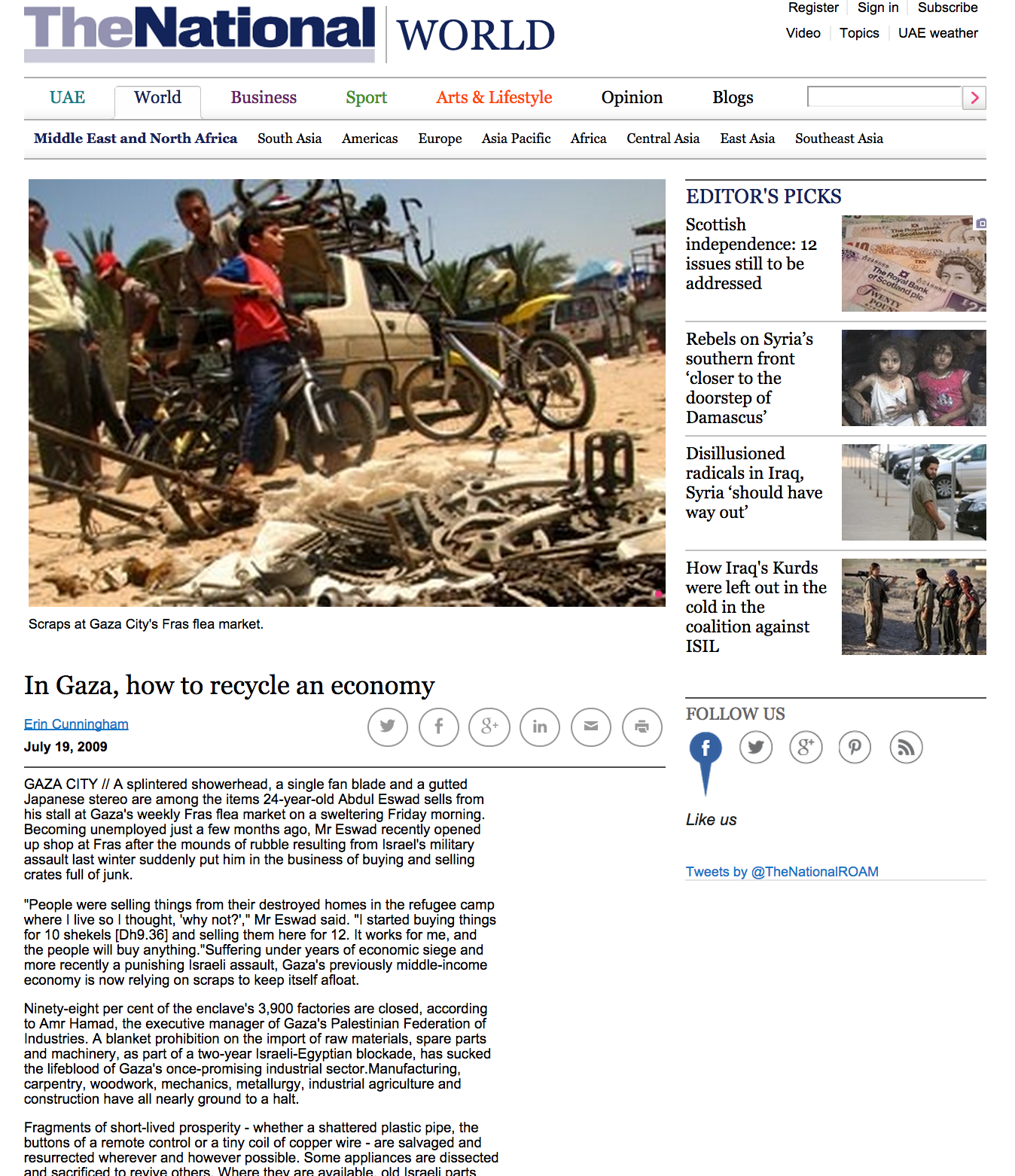
In Gaza, how to recycle an economy

The National (July 2009) - Shortages of materials, spare parts and imported goods in Gaza mean residents and businessmen repurpose everything they can get their hands on.

"Despite the death of Gaza's formal industry, here it feels like at least someone - or something - is at work. "Necessity is the mother of invention" seems a fitting motto for this tiny bazaar of scraps."

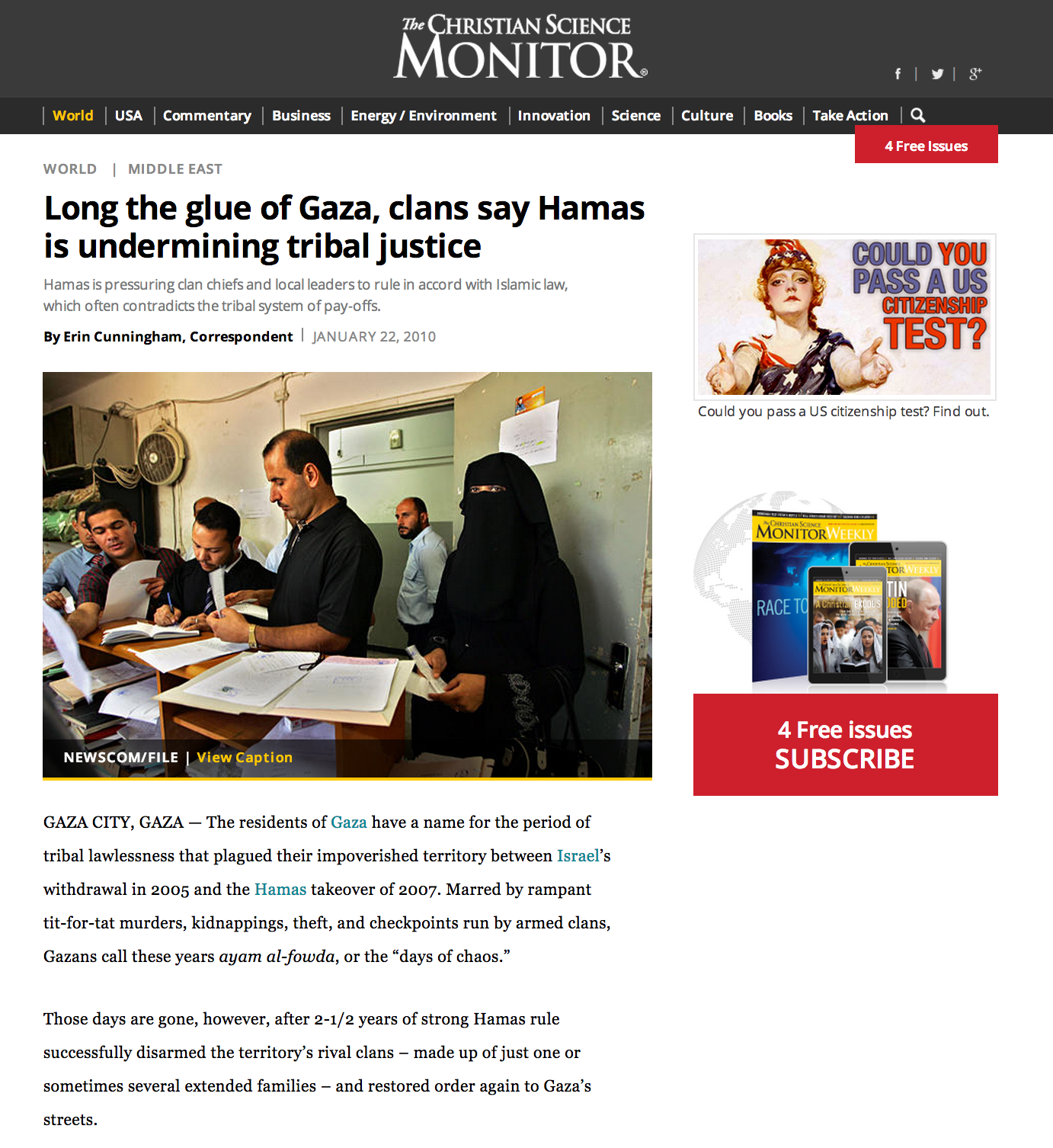
Long the glue of Gaza, clans say Hamas is undermining tribal justice

Christian Science Monitor (January 2010) - Hamas disarms Gaza's clans, but leaders of prominent families there say that the Islamist group is stepping onto territory outside its jurisdiction.

"Any overt politicization of the chiefs, historically seen as societal mediators in Gaza, may end up threatening the independence of a system experts say has regulated Gazan society at the grass-roots for centuries."

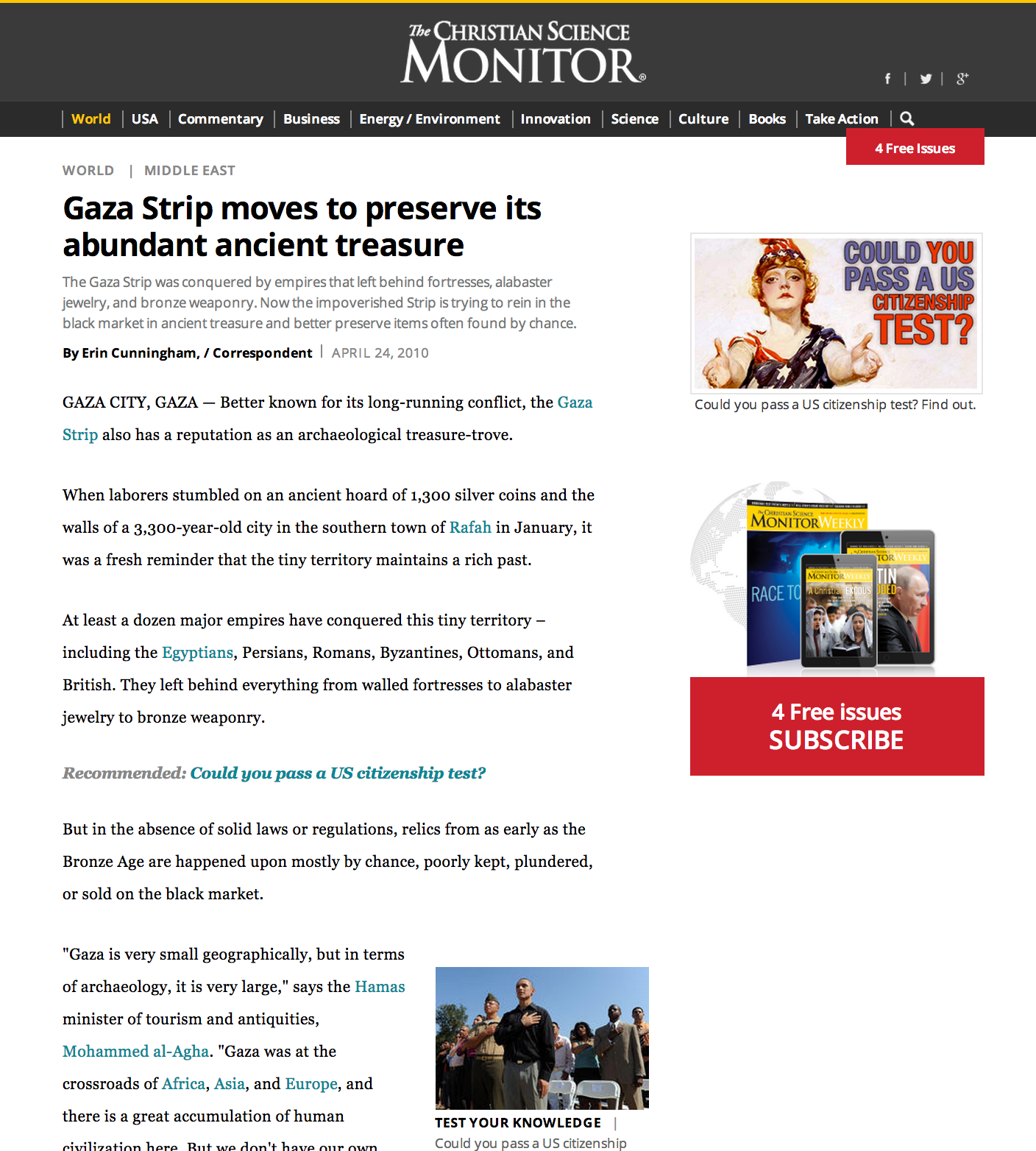
Gaza Strip moves to preserve its abundant ancient treasure

Christian Science Monitor (April 2010) - Erin looks at Gaza's illicit trade in archaeological artefacts. Gaza's location and history - many empires have passed through - means that the area is disproportionately seeded with old items of historical interest.

""An ancient piece the size of a cellphone from the Pharaonic or Canaanite eras easily sells for $1 million on the black market," says Abu Ahmed, a dealer involved in the underground antiquity trade. "And I used to make a major deal every month.""

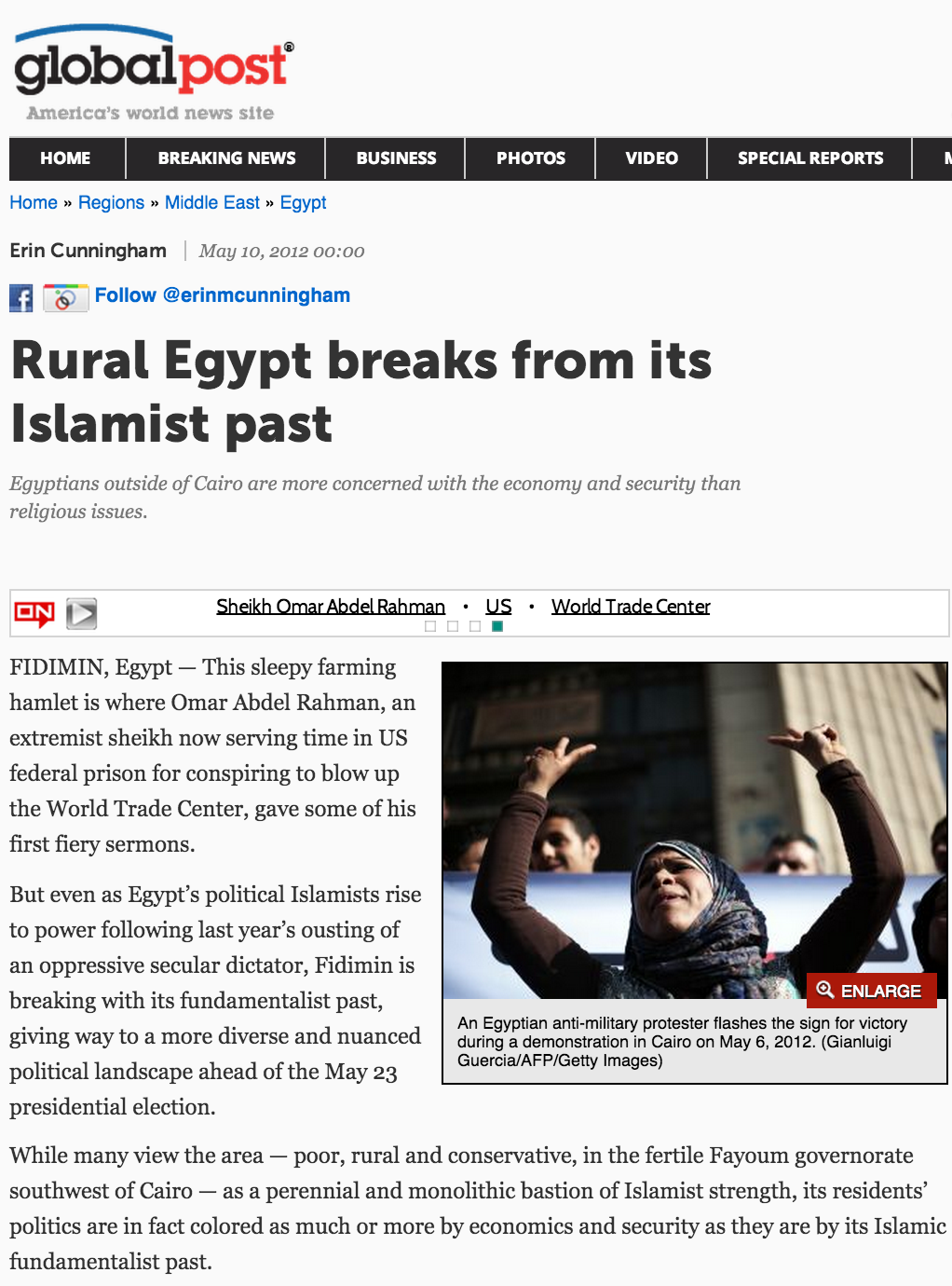
Rural Egypt breaks from its Islamist past

Global Post (May 2012) - Ahead of the May 2012 presidential election in Egypt, Erin visits a small town in rural Egypt showing how things have changed. Historically supportive of Islamist politicians, the area now has more day-to-day concerns:

"At the forefront of most people’s concerns here is not Islamic law — in fact, few even mention it — but the need to resuscitate an ailing national economy that has left them even more impoverished, and to halt growing insecurity and drug use."

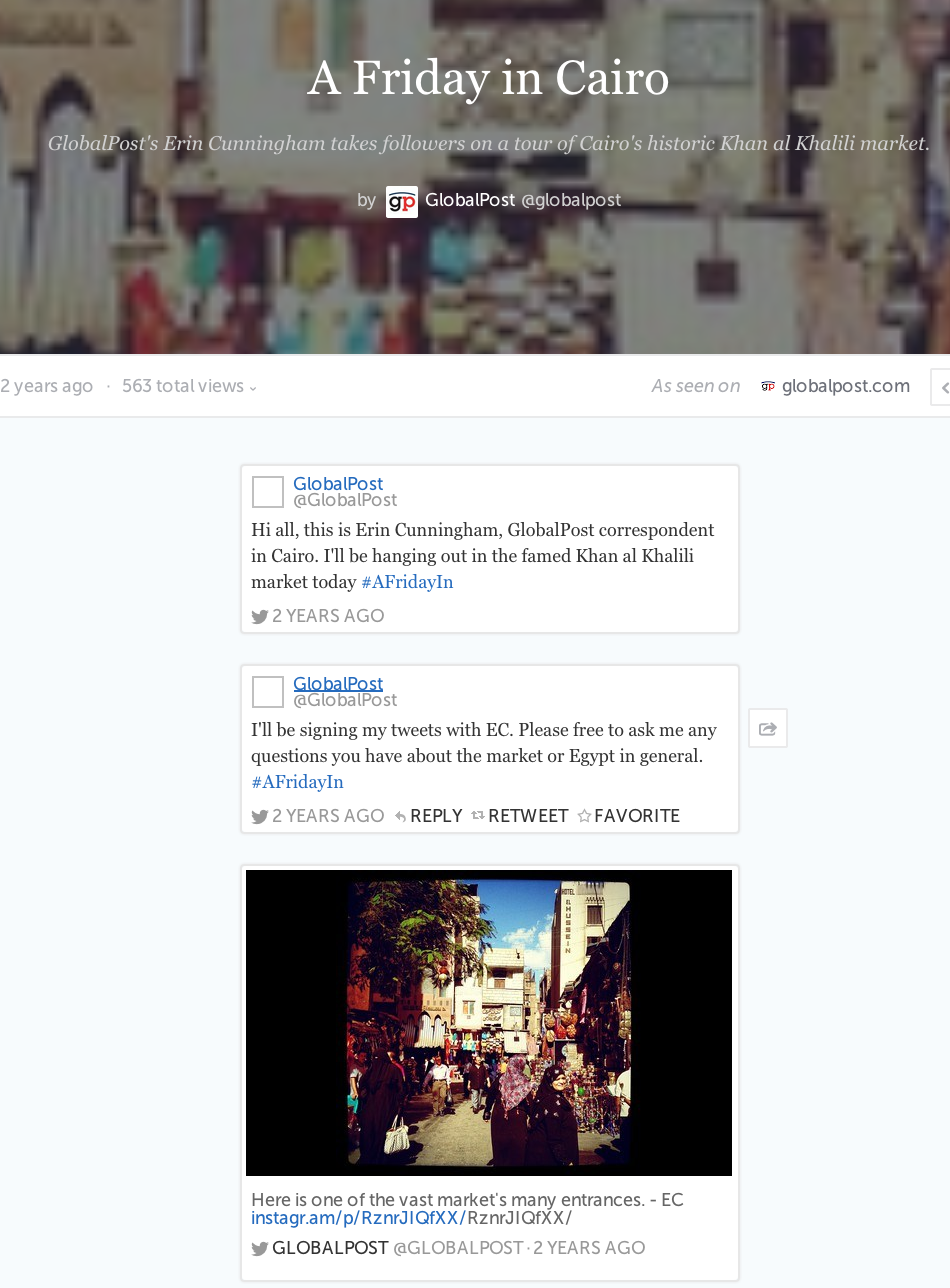
A Friday in Cairo

Twitter/Storify (November 2012) - Erin spends a Friday tweeting from and about Cairo, taking a walk through the city's famous Khan al-Khalili market to give a sense of what it's like around her. It's a mix of pithy social observation, sightings of cats and unique photos as found on her Instagram account.

"braved the Cairo traffic & Friday morning crowds, so now plopped down at the market's most famous cafe for a Turkish coffee #AFriAFridayInC"

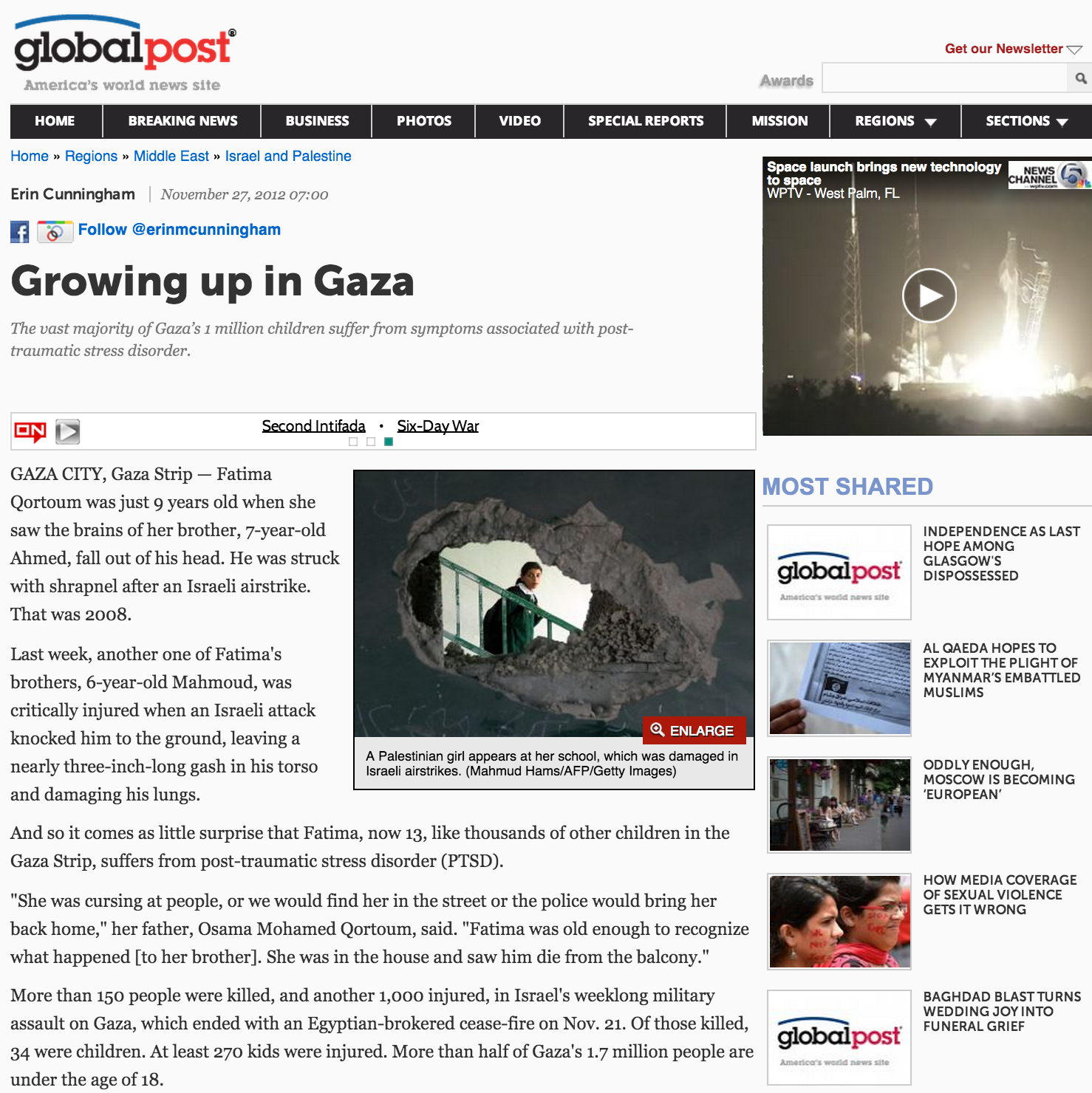
Growing up in Gaza

Global Post (November 2012) - Life is tough for children in Gaza. The dangers of war (as witnesses and victims) are ever present and psychological symptoms are widespread.

""They listen to the radio, they watch TV, they see the dead bodies, they hear the bombs, they feel the shattering of the glass from the windows in their homes, and they listen to stories" of war, said Eyad Sarraj, a mental health expert and founder of the Gaza Community Mental Health Program. "So they are terrified.""

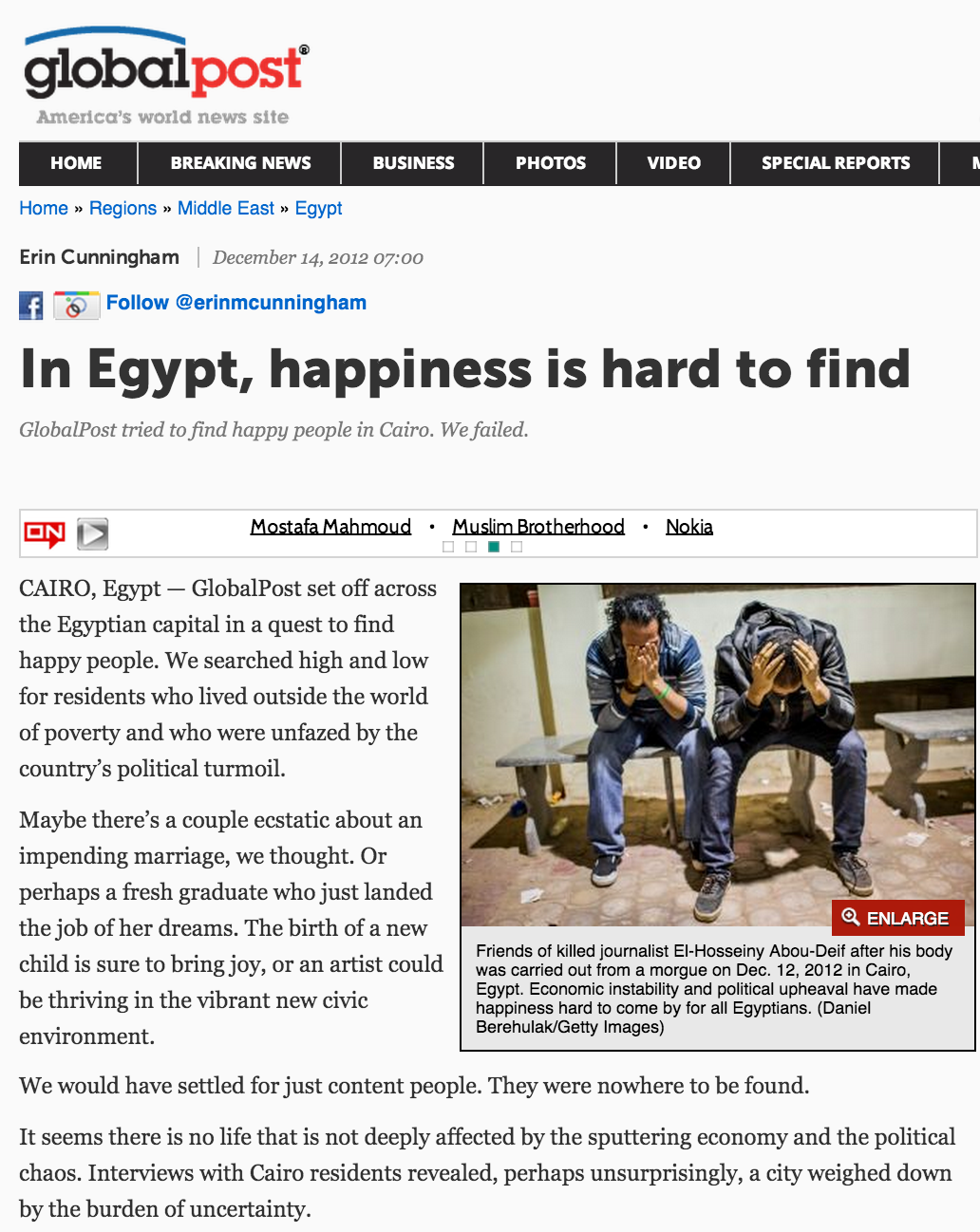
In Egypt, happiness is hard to find

Global Post (December 2012) - Something a little more lighthearted: Erin tries to find people with a positive take on developments. It turns out to be far harder than expected.

"We would have settled for just content people. They were nowhere to be found. It seems there is no life that is not deeply affected by the sputtering economy and the political chaos. Interviews with Cairo residents revealed, perhaps unsurprisingly, a city weighed down by the burden of uncertainty."

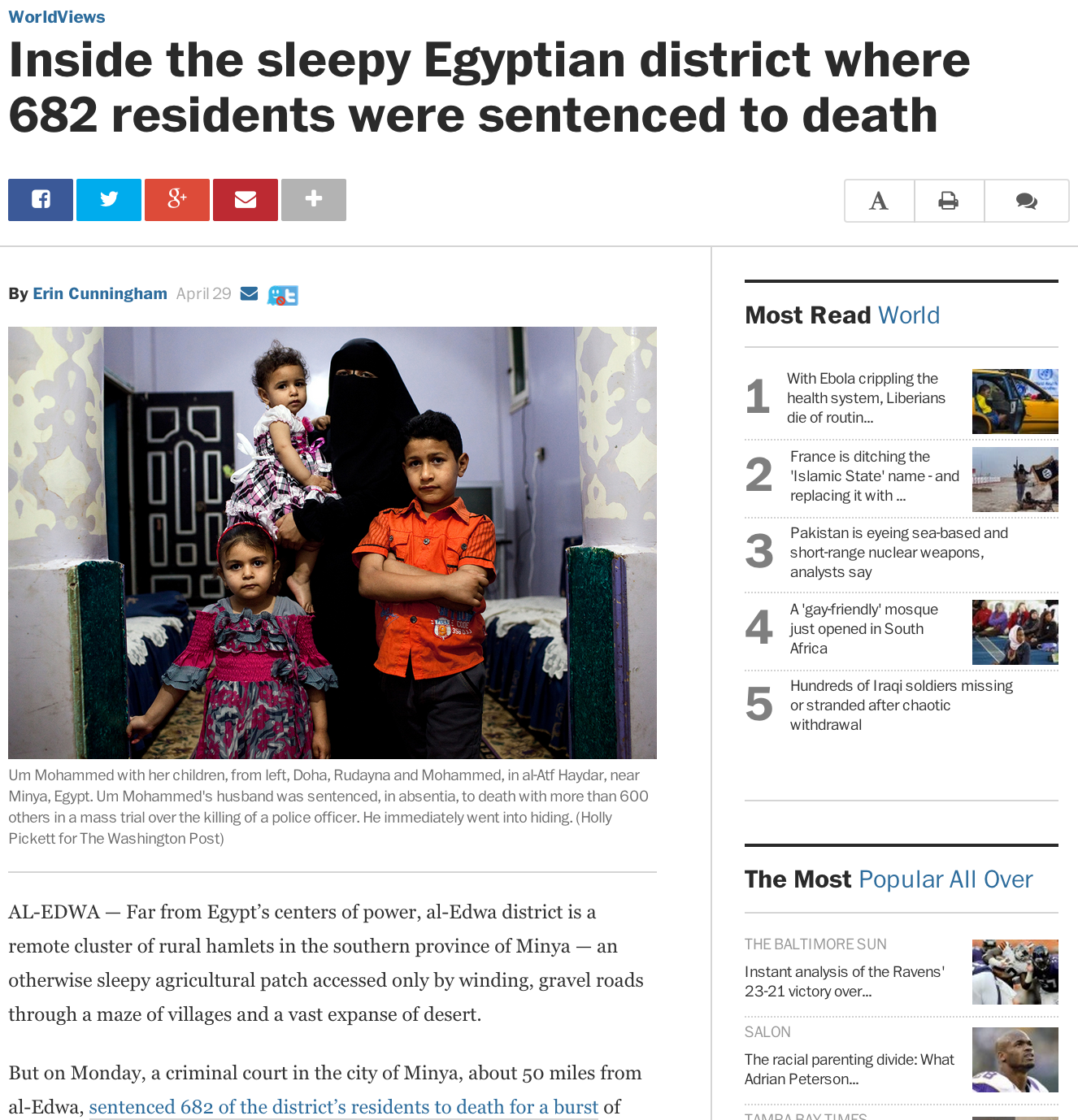
Inside the sleepy Egyptian district where 682 residents were sentenced to death

Washington Post (April 2014) - Erin travels to the rural south of Egypt to interview those sentenced following a harsh state crackdown following pro-Islamist demonstrations. It was the country's largest ever mass death sentence.

"Far from Egypt’s centers of power, al-Edwa district is a remote cluster of rural hamlets in the southern province of Minya — an otherwise sleepy agricultural patch accessed only by winding, gravel roads through a maze of villages and a vast expanse of desert."

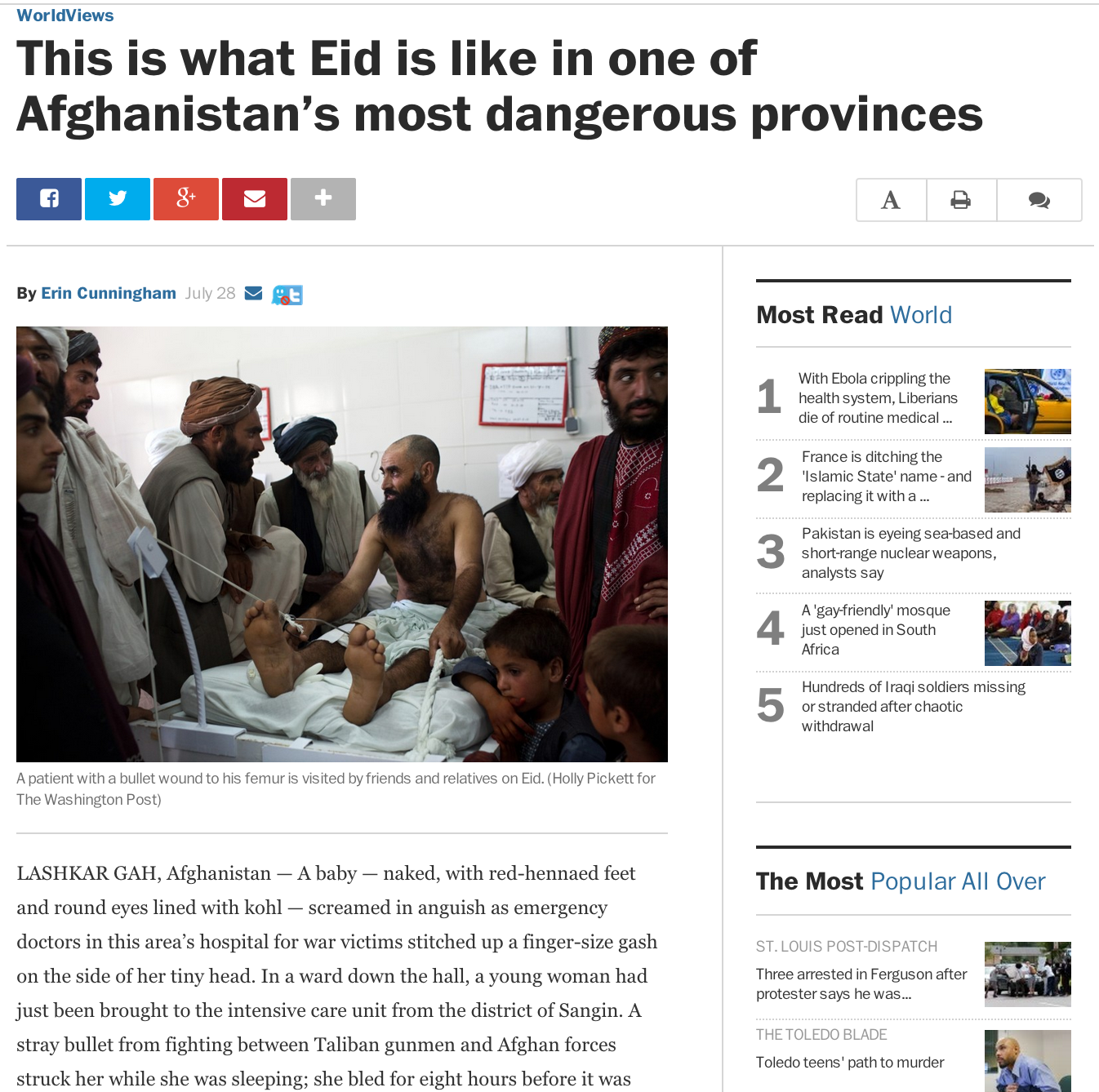
This is what Eid is like in one of Afghanistan’s most dangerous provinces

Washington Post (July 2014) - A visit to a hospital in southern Afghanistan brings home the price civilian victims must pay in the ongoing conflict.

"A baby — naked, with red-hennaed feet and round eyes lined with kohl — screamed in anguish as emergency doctors in this area’s hospital for war victims stitched up a finger-size gash on the side of her tiny head. In a ward down the hall, a young woman had just been brought to the intensive care unit from the district of Sangin. A stray bullet from fighting between Taliban gunmen and Afghan forces struck her while she was sleeping; she bled for eight hours before it was safe to leave for the hospital." 

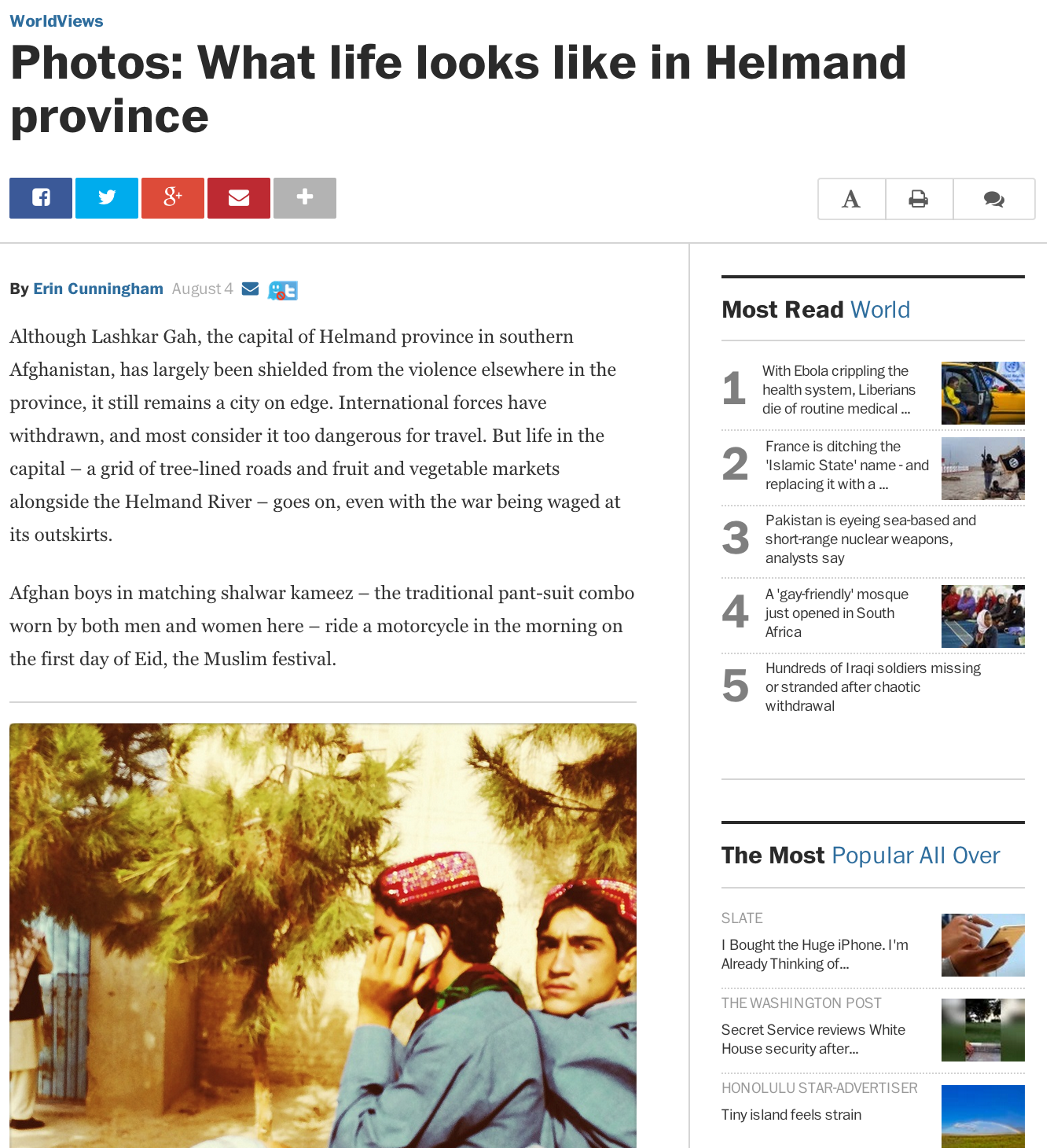
Photos: What life looks like in Helmand province

Washington Post (August 2014) - Erin's Instagram photos make their way into the Washington Post, this time from her trip to Helmand province in Afghanistan.

These and many more are available at the link above or at on her dedicated Instagram page.

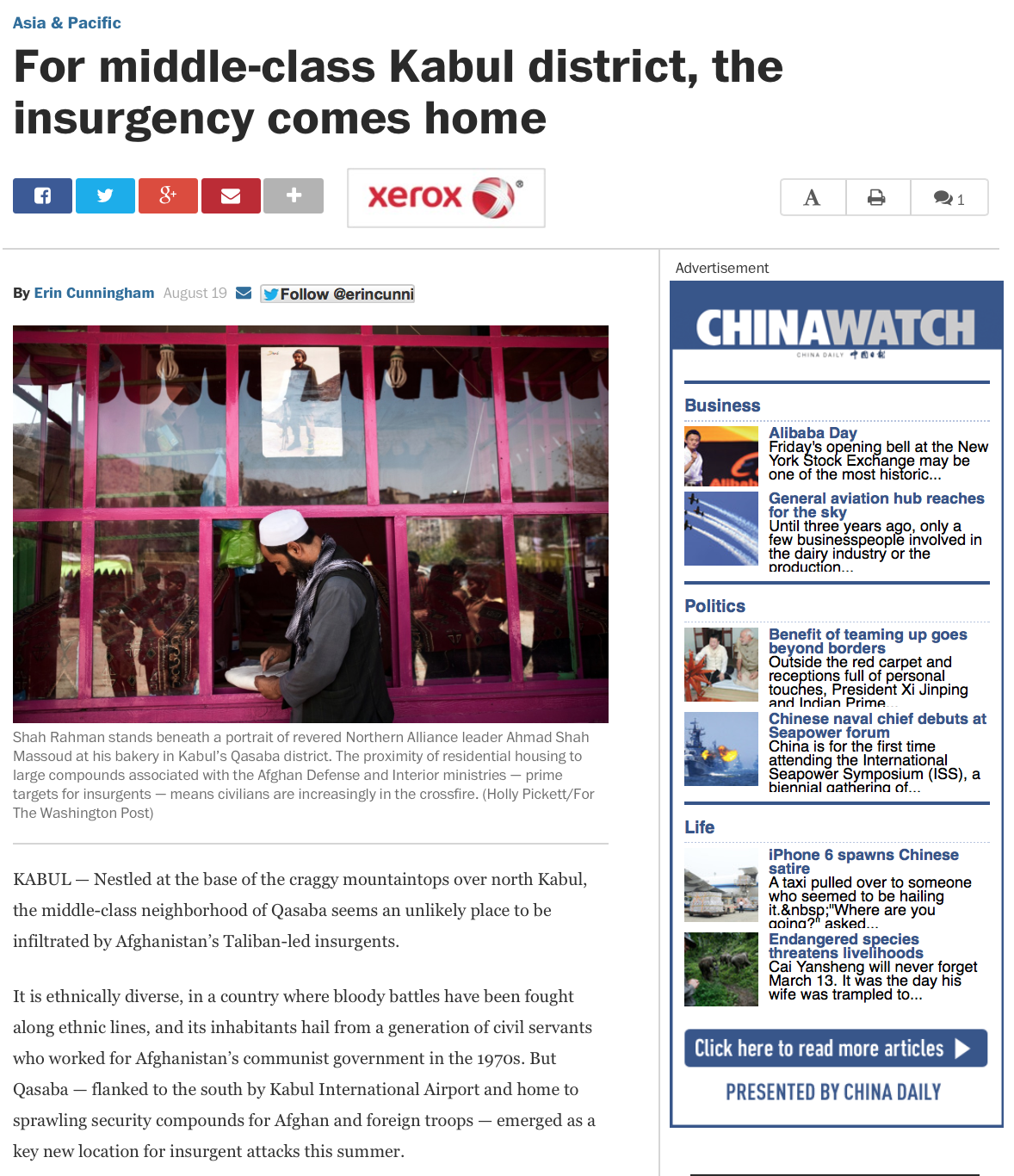
For middle-class Kabul district, the insurgency comes home

Washington Post (August 2014) - Erin visits a neighbourhood of Afghanistan's capital that has seen a larger than usual rise in violence. She talks to the families who live there.

"At sunset on this summer day, a commercial airliner took off with a roar, making a sharp ascent over the rugged peaks. Microbuses trundled up the steep mountainsides to ferry laborers home from work, the men bringing home pink plastic bags brimming with cucumbers, carrots and okra for their evening meal.

“I grew up with war, but the children,” Qassim said, trailing off. “We wish the bases would move.”"


Show Notes:

1:00 - National Book Award


1:22 - US Ambassador / Boston University Chat


4:32 Regarding Western Media Shrinking Overseas Bureaus:

- Formal analysis from the American Journalism Review on the issue from 2011

- A look back on the same issue from as far back as 1998, also by the American Journalism Review


7:02 - Operation Cast Lead

A three-week armed conflict between Palestinians in the Gaza Strip and Israel that began on 27 December 2008 and ended on 18 January 2009 in a unilateral ceasefire.


9:01 - Inter Press Service (official link)

Inter Press Service (Wikipedia Page)


10:49 - Watching Peter Arnett describe the First Gulf War


13:00 - Studying Arabic in Cairo:

The American University of Cairo

Cairo Ain Shams University in Cairo

AMIDEAST Arabic Study in Cairo


16:30 - Idea. Erin: It’s important to portray the Middle East as a region full of ordinary people, important to speak to ordinary people and speak to the issues of their lives.


18:45 - Why I Decided War Reporting Was No Longer Worth The Risk by Tom A. Peter, in The New Republic

Quoted paragraphs:


“Never before have Americans disliked journalists as much as they do now. Political coverage, which tends to be most contentious—and also to most influence perceptions of the press in general, thanks to its prominence—remains relentlessly even-handed, as a meta analysis of decades of presidential campaign reporting by University of Connecticut professor David D'Alessio has shown. Yet readers believe the opposite. In a 2011 Pew Research Center survey, two-thirds of respondents said that news stories are often inaccurate. About a third said the news media is “not professional.” Forty-two percent described the news media as immoral, with only 38 percent judging the profession as moral.

Working overseas, I rarely thought about how people process the news. To be certain, I never imagined people clamoring for foreign reporting. I assumed most people were indifferent but I took comfort in knowing that my profession provided a public record readily available if or when a person decided to devote time to an issue. More than anything, I worked as a journalist because I loved the day-to-day hustle. A possible higher purpose was what convinced me it was worth it when bad things happened, like getting caught up in an air strike or having a roadside bomb explode under the truck just in front of me.”


22:43 - Idea. Erin: It’s such an important time in the region, and to be a part of that, to speak to the people participating or affecting or being affected, it’s really amazing.


26:50 - Idea. Erin: What does foreign reporting accomplish? Maybe nothing. Can’t say for certain that it accomplishes anything.


35:50 - Erin’s Twitter account


36:07 - The Arabist Blog

Arabist.net was launched in Cairo in November 2003, by Issandr El Amrani, partly as response to the the lack of interest in the domestic politics of Arab countries in much Western media. It focuses on Egypt but tries to follow broader issues in the Arab world, US policy in the Middle East and cultural developments throughout the region.


36:48 - Omar Ashour

Omar Ashour is a nonresident fellow at the Brookings Doha Center. His research focuses on jihadism, democratization, security sector reform and civil-military relations, armed conflict, and Islamist movements and ideologies in North Africa, the Middle East, and Central Asia. He is a lecturer in politics and director of the Middle East Politics Graduate Studies Program at the University of Exeter. He is the author of The De-Radicalization of Jihadists: Transforming Armed Islamist Movements.


37:38 - Kareem Shaheen, journalist with The Daily Star, a Lebanese newspaper


41:45 - ISIS


44:40 - Erin’s information is organized mainly by folders by country, then subject. Adds in color, interviews, tweets, etc to flesh out this information. It’s all backed up on Google Drive.


46:40 - Instapaper


48:45 - Goodreads


49:30 - Erin’s Instagram Account


53:20 - Erin’s Book Recommendation:

Drinking the Sea at Gaza: Days and Nights in a Land Under Siege, by Amira Hass


55:03 - Matt’s reads this week:

Dark Continent, Europe’s Twentieth Century by Mark Mazower

Excellent Sheep: The Miseducation of the American Elite and the Way to a Meaningful Life by William Deresiewicz

Recommendations taken from Farnam Street Blog by Shane Parrish


56:40 - Erin’s Film: Iraq in Fragments by James Longley

Film trailer:

Interview with James Longley about the film:


59:30 - Alex's pick: Goldmedalbodies.com for exercises for keeping flexible and healthy outside of just going to the gym or running.


1:00:00 - Erin’s Song: Soulshine by DJ Cam

Sources and Methods #1: Anand Gopal

Alex and Matt are joined by writer, journalist and polymath Anand Gopal for our inaugural episode. He talks about writing books, reporting in Afghanistan, how he stays on top of the news from a variety of countries, why it's so important to learn languages and many other things.

Anand Gopal 101: What You Need To Read

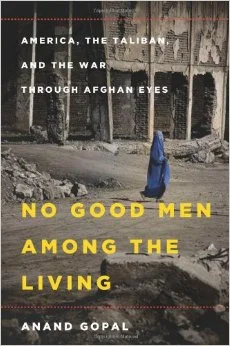
No Good Men Among The Living (2014)

Foreword to I Am Akbar Agha: Memories of the Afghan Jihad and the Taliban (2014)

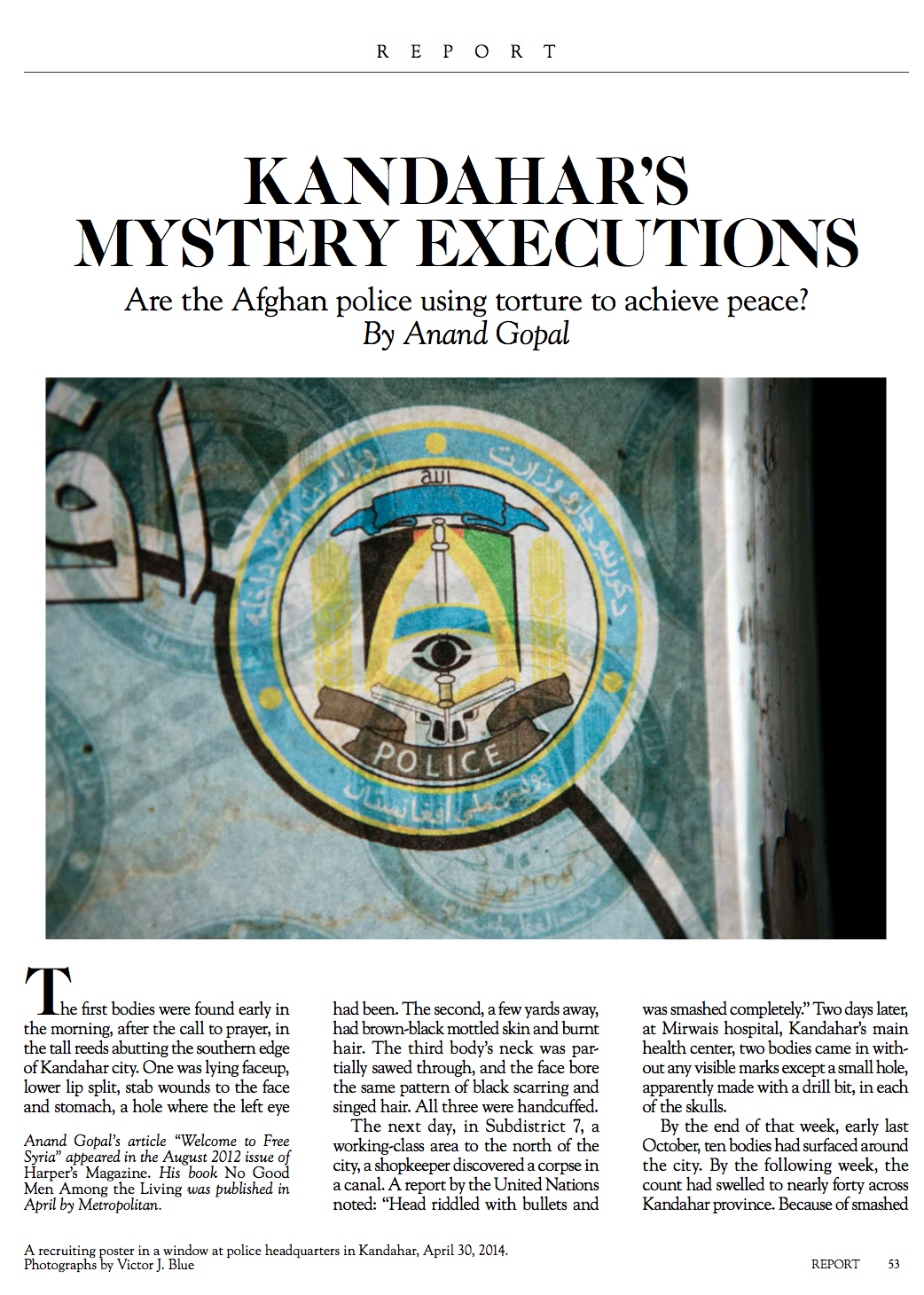
"Kandahar's Mystery Executions" (Harper's) (2014) (read it here)

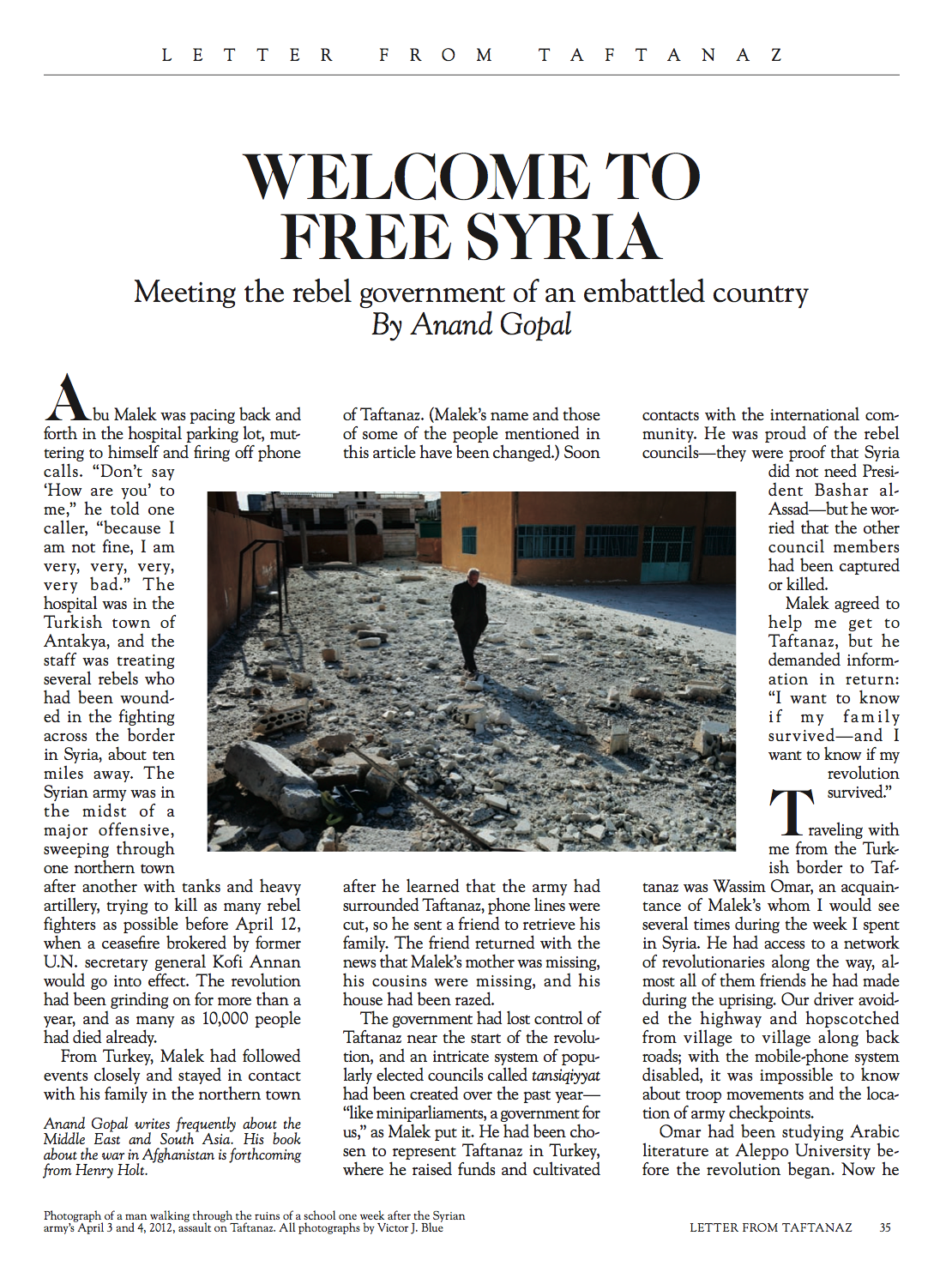
"Welcome to Free Syria" (Harper's) (2012)

"Decoding the Syrian Propaganda War" (Harper's Blog) (2012)

"Militancy and Conflict in Kandahar" (New America Foundation report) (2010)

"Qayyum Zakir: The Taliban's Rising Mastermind" (Christian Science Monitor profile) (2010)

"Pakistan Arrests Senior Taliban Leaders" (Wall Street Journal) (2010)

"U.S. Plan To Arm Afghan Militia Founders On Tribal Rivalries" (Christian Science Monitor) (2010)


Show Notes:


0:00

Anand at the New America Foundation

Book: Quantum Theory For The Rest of Us by Anand Gopal

Book:  My Life With the Taliban by Felix / Alex

Book: No Good Men Among The Living by Anand Gopal


6:20

Anand’s New America Foundation Article: The Battle for Afghanistan: Conflict and Militancy in Kandahar


8:19

Lexis Nexis (Wikipedia link) - a powerful research tool useful for examining the public record, particularly archives of major newspapers


13:35

Anand Gopal’s Harper’s Article ("Kandahar's Mystery Executions")


22:20

Anand’s Work in Syria:

Welcome to Free Syria - Harper’s, August 2012

Syria’s Summer of Stalemate - Harper’s, September 2012


26:00

Twitter thoughts:

Set up a list of people regularly tweeting interesting things - create a list of people who can help curate information sources for you. (Mashable: "How to Use Twitter Lists").


29:00

Taftanaz, Syria


33:00

News.me: Get the top stories being shared on Facebook and Twitter in a handy email newsletter every day

Libya Twitter:

Chris Stephen (@ReportingLibya)

Afghanistan Twitter:

Taimoor Shah

Matt Aikins

Afghanistan Analysts Network

Borhan Osman

Three Quarks Daily - Science website, newsletter

Medical Skeptic

Neuroskeptic


39:00

To pick his next book - uses goodreads.com

Anand's Goodreads profile


40:15

Amazon.com wishlists

LibraryThing


40:59

Feynman Method Reading Technique


41:30

Devonthink - information organization assistant

Get at the chain of reasoning of an argument

Anki - Spaced Repetition Software

Forgetting Curve (Wikipedia)


45:30

The Myth of Religious Violence by William T. Cavanaugh


48:14

Python - computer programming language

Udacity - online courses

Udacity CS101 ("Intro to Computer Science: Building a Search Engine")

Udacity CS215 ("Intro to Algorithms: Social Network Analysis")


51:15

Memorization as the key to creativity

Andrew Abbott (Wikipedia) sociologist


52:20

Confirmation Bias


53:30

Random App - gives a random new story mixed in with chosen categories

Film - The Wind That Shakes The Barley by Ken Loach

Book - The Unforgiving Years by Victor Serge

Song - The Alabama Three: Vietnamistan

Book most given as a gift: The Unfolding of Language by Guy Deutchser


Time travel: 1917